Stormy Weather Photography. . .

Late fall and winter weather is happening in the northern hemisphere, and it presents different photography challenges. The weather plays an important part at this time of the year. It is more likely to be windy, stormy, rainy, foggy or snowy at our outdoor destinations. The leaves have left the trees in many areas, giving fewer hiding places for wildlife and birds. The landscape takes on a different “feeling” than the warmer months of spring and summer. The colors change, and daylight hours are shorter.

During strong winds and stormy weather, birds seek refuge in sheltered areas. This image below was taken during strong winds. This great blue heron is sheltered from the winds by the marsh grasses, and is feeding in the shallow water. In this image, he is cleaning his feet. There were several great blue heron roosting in the tall grass behind this bird. The weather brought these birds closer to the walk-way through the marsh, and made them easier to photograph. Other birds finding shelter in the marsh were Northern Shovelers (ducks) and Killdeer. Small song birds were feeding in the cattails and trees.

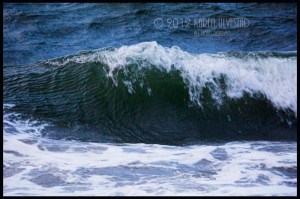
copyright Karen UlvestadThe beach is a wonderful location during high winds or stormy weather. In this photograph, the wave is coming into shore, and is about 4-6 feet tall. It wasn’t raining, but the winds were very strong. It is good to watch the surf, before going onto the beach, to see where the high-water mark is at. Even with this information, the wind can send waves higher on the beach. On the ocean, these are called sneaker-waves. They can pull people into the water, and can be deadly. It is important to be prepared for the environment and weather.
copyright Karen UlvestadIt is important to wear the appropriate clothing for adventures during the winter. Hypothermia can affect those who are not prepared for rain, wind, snow and colder temperatures. It is good to dress in layers, with a good water-repellent shell over the top. The wind will drop the temperature (wind-chill factor), and the cold can hurt exposed areas of skin (hands, fingers and faces). It is important to wear footwear that will keep feet warm and dry. This type of equipment can be found at outdoors stores, such as ski shops or REI.

Camera batteries will lose their charge faster in the colder weather. It is good to bring an extra battery, and keep it in a warm place (pocket near body heat). Most camera equipment is water-resistant, but it depends on the manufacturer and model of the equipment. It is good to keep the gear dry with a good camera bag (water-proof), covering for the camera/lenses and a quick-dry cloth to dry any water that does get onto the equipment.

The photograph below illustrates being prepared for the weather. More later. . .

copyright Karen UlvestadHappy Shooting. . .Karen

Day adventures to relieve holiday stress

The holidays can be a stressful time for everyone. There are more people on the roads, in stores, and everything seems to take longer. A great way to keep perspective is to step away from the crowds and take a day to relax. These locations are great for Photographers. Each offers many opportunities to photograph landscape, people and wildlife. Please check it out, like it and enjoy. . .thank you. . .

For the entire article, go to Day adventures to relieve holiday stress.

Exploring the redwood forest in northern California

This is one of my favorite places to visit, explore and photograph. The redwood forest is beautiful at any time of the year, though it can rain and be very stormy in the winter months. Please check it out, and hope you enjoy. . .

For the entire article and slideshow, visit Exploring the redwood forest in northern California.

Fall colors at western Oregon vineyards

I love the wineries and vineyards in Northwestern Oregon at this time of the year. The vineyards turn beautiful colors, and the old farm houses stand-out against all the color. This is my latest article about northern Oregon. Please check it out. . .hope you enjoy. . .

For the complete article and slide-show, visit Fall colors at western Oregon vineyards.

It’s time for snow in the north Cascade Mountains

This is a great area to photograph the mountains, bald eagles and other wildlife. Please check out the link to read the rest of the article.

It’s time for snow in the north Cascade Mountains.

Northern California Coast Adventures

Here is my latest article on the northern California coast.  It is part 1 in a series.  For the entire article, please visit Northern California Coast Adventures.

Creating a Sense of Depth in a Photograph

Landscape or cityscape photography depends on a sense of depth in the photograph.  The idea is to show the details in the landscape, while telling a story about the place.  Composition goes “hand-in-hand” with exposure of wild places, or structured cityscapes.  This type of photography usually has a fore-ground, mid-ground and background, which leads the viewer through the image.

In this first photograph, the fore-ground is the water.  The mid-ground is the small spit of land on the left and what looks like ice on the water.  The background is the mountain covered in snow.  With the Aperture set at F11, the Depth of Field (DOF) starts in the mid-ground, and continues through the background.  The inclusion of the fore-ground and mid-ground gives the viewer information about the location of the photograph.  It contributes to the “story” of the place.

copyright Karen Ulvestad
Exposure for this photograph is 100 ISO, 1/100 sec at F11. It was shot with my 100-400mm lens at 400mm.

This second photograph was taken in a Filbert orchard in Oregon.  I used the lines of the trees to create the feeling of depth.  Using natural or man-made lines adds to the DOF in the image.  The aperture for this photograph is F10, and the tree at the end of the row gives a sense of distance.  In this one, I used complimentary colors (red and green) to add to the composition.  This was taken in the early spring, before the leaves had come out on the trees.

copyright Karen Ulvestad
The exposure for this photograph is 100 ISO, 1/40 sec and F10. It was shot with my 100-400mm lens at 100mm.

This last photograph is taken with a wide-angle lens.  I shoot with a full-frame sensor camera, which makes 17mm a wide-angle lens.  For those shooting with a cropped sensor in their cameras, wide-angle lens size starts at 14mm.  I used the fore-ground (rocks) to five a focus point for the photograph, and the ferry docks add a nice line.  The lights from the dock spill out across the water, and create nice lines to counter the horizon line.  In addition, I shot this one with the lit ferry boat coming into the docks.  This was taken about 20 minutes after sunset.

copyright Karen Ulvestad
The exposure for this photograph is 400 ISO, .4 sec at F7.1. It was shot with my 17-40mm lens at 17mm

More Later & Happy Shooting. . .Karen

Great fall adventures on the coast

The Oregon coast is a great place to visit in the fall. The weather is pleasant, and it offers great opportunities for photography. Please check it out. If you enjoy the articles, please consider subscribing to receive them via email. Hope you enjoy. . .

For the complete article, visit Great fall adventures on the coast.

Fall colors in the Cascade mountains

The fall colors east of the Cascades are reaching their peak color. . .

For the complete story, visit Fall colors in the Cascade mountains.

Southern coast adventures for the whole family

This is a wonderful area to photograph.  The sunsets are spectacular with all the sea stacks against the colors of the sky.  Please check out my article and like it.  Thanks & Happy Shooting. . .Karen

Southern coast adventures for the whole family.