Great Photography Weekend Destinations

copyright Karen Ulvestad
Leavenworth, WA

Leavenworth is a wonderful day or weekend adventure for all ages. The town schedules year-round festivals, and is located in the scenic eastern foothills of the Cascade Mountains. Highway 2 travels through the town, and is the easiest way to reach this beautiful destination.

On the way to Leavenworth, Stevens Pass is a beautiful area for photography. On the west side, there is Deception Falls, and it is well worth the stop. The trails lead to the falls (which can be seen on the south side of the highway), and along the river. Stevens Pass ski resort is at the top of the pass, and is a wonderful alpine area in the summer months. On the east side of the pass, Lake Wenatchee is about 5 +/- miles to the north, and the view looks into the Cascade Mountains. Highway 2 traverses through Tumwater Canyon, which has several pull-outs for safe observation of the scenery and wildlife.

copyright Karen Ulvestad
Tumwater Canyon

In the opposite direction, the Olympic Peninsula offers incredible opportunities of photography. This area is home to a large temperate rainforest, Olympic National Park, beautiful waterfalls, Lake Crescent, and the Pacific Ocean. There are many hiking trails through-out the area, including the North-South trail through the heart of the Olympic National Park. Highway 101 travels through the area, and signs show the directions to the scenic areas.

copyright Karen Ulvestad
Olympic National Park

Lake Crescent sits just west of Port Angeles, and has both a campground and cabins/lodge on its shores. It is part of the Olympic National Park, and the highway follows the shoreline of the lake. It’s nestled between tall foothills, and surrounded by forest. There are many pull-outs along the lake to view the area, or hike a trail. The light is incredible during the early or late hours of the day, and it is not uncommon to have overcast/foggy conditions in the area.

Further on, Highway 101 travels through the town of Forks, and onto the Pacific Ocean Beaches. There are several beach back-packing trails in this area, and Third Beach is one of the longest. It is a great way to see parts of the coastline that most people don’t see. There is a lot of wildlife in the area, and incredible landscape photography opportunities.

copyright Karen Ulvestad
Hiking on a Pacific Ocean beach.

For more information, visit http://seattle.cbslocal.com/top-lists/best-weekend-getaways-in-the-seattle-area/.

September is the time for the Puget Sound Bird Fest

Western Sandpiper

Every September, the Puget Sound Bird Fest is held in Edmonds at the Frances Anderson Center, and surrounding area. This year, the festival is being held Friday, September 6 through Sunday, September 8. The festival is put on by the City of Edmonds. Each year, the festival is an opportunity to attend a workshop, participate in a guided birding tour, kayak to observe birds, meet professionals in the birding field, and learn about birding. For more information, visit the article at September is the time for the Puget Sound Bird Fest.

Note: I will be giving a Free lecture on Bird Photography.

Photographing Nesting Bird Colonies

I returned from teaching a fantastic workshop at Sitka on the Oregon coast last Thursday. We had the opportunity to photograph thousands of nesting birds. The low tide offered us an opportunity to walk closer to the bird colonies, and gave an opportunity to see tide pools filled with marine life. The lower rocks were filled with Harbor Seals.

One of the biggest parts of the class was learning to make order out of the pandemonium of the scene. The air is filled with the calls of the birds, the ocean waves are crashing on the rocky shoreline, and the constant movement of the birds. The area had over 60,000 nesting seabirds, raptors and songbirds. The species most prevalent were Common Murre, Brandt’s Cormorants, Pelagic Cormorants, Peregrine Falcon, Bald Eagle, White-crested Sparrow, Turkey Vultures, Gulls, and Great Blue Heron.

copyright Karen Ulvestad

The photo above is a small section of the Common Murre colony. Often times, these areas are windy. It is advisable to use a lens with Image Stabilization (Vibration Reduction, etc.), or a sturdy tripod, when photographing the birds. Video clips always require a stable tripod.

The photograph below was taken from the beach looking up at the birds. These nesting areas usually have several species of birds nesting together, though each has a “zone” they will use. In this instance, the birds at the top are mostly Common Murre, while the Cormorants are intermingled or below. The lowest level in this image would be the Gulls.

copyright Karen Ulvestad

In addition to all the visual, audio, and physical input, it is important to remember to think about composition, exposure, and focus. The image below was visualized before being taken. The composition is relatively simple. The exposure allows the fore-ground to silhouette against the sky. These are the pieces that create the successful image within the arena of pandemonium of the scene.

My next workshop on Bird & Wildlife photography will be July 27 & 28, 2013 through the Pacific Northwest Art School.

Happy Shooting. . .Karen

copyright Karen Ulvestad

Of the Land, Sea & Air – A Coastal Photographic Adventure


copyright Karen Ulvestad
This bald eagle is flying in after missing a fish in the ocean. This is at Neskowin.

“It was perfect for all levels. It was a great combination of technique and artistry.” Susan H.

We will have minus tides during this workshop, which will allow students to view and photograph tide pools, walk closer to bird nesting areas and marine mammal resting areas. It’s a great opportunity to learn the details of bird and marine mammal photography, and shoot at beautiful locations. The coastal waters are filled with harbor seals, gray whales, and sea birds during the late spring season.

copyright Karen Ulvestad
These are nesting cormorants on the Oregon coast. These can be viewed at low tides, in the nesting season.

The workshop starts in the classroom, with an interactive presentation about exposure, techniques and equipment. Then, students go out into the field and practice what was learned in the classroom, ask questions and learn how to spot wildlife. Composition is discussed through-out the workshop, both in the classroom and in the field. The workshop is about 30% in the classroom and 70% shooting in the field with instruction.

copyright Karen Ulvestad
This California sea lion was resting on the rocks.

This last photograph is the students photographing harbor seals in the surf. Most of the subjects can be photographed with a 400mm lens or shorter. It is recommended that students bring a tripod. For more information or to sign-up, visit Sitka Center.

copyright Karen Ulvestad
Last year’s workshop students are photographing harbor seals playing in the surf.

A Great Blue Heron Story. . .

Great Blue Heron are a bird that survives in urban and wilderness areas. They eat frogs, small rodents, fish, crabs, and more. They nest in colonies or rookeries that can be home to a hundred or more birds. These herons are majestic in their demeanor, territorial while hunting, and tolerant during nesting.

The photo below is taken at an urban area rookery that sits near Lake Washington in Kenmore. The photo below shows the entire rookery. Currently, there are about 50 +/- nests in the trees, and 100+/- Great Blue Herons. It’s quite a sight, though challenging to photograph. The wetlands are fenced off, so photography happens from the park-n-ride parking lot, or along the back entrance.

copyright Karen Ulvestad

The photo below shows the nesting pairs and their nests. Often, there are single birds vying for the attentions of another bird, or pairs looking for a nesting site. I counted about 28-30 nests in this tree alone. Surprisingly, the colony is relatively quiet. These photos were taken at mid-day, and fortunately, there were interesting clouds in the sky for the background. I’ve photographed this rookery before, I had the fortune of stormy weather and a rainbow.

Tip: Aperture is important while shooting a Rookery. Most of these images were shot with f5.6-f8.

copyright Karen Ulvestad

This next image is of a nesting pair building their nest. He is bringing sticks, and she is placing them into the nest. I watched him bring one stick at a time, watch her place it in the nest, and he would preen her feathers during the process. It’s a difficult area to photograph the herons flying into their nesting sites, so scouting the location and planning is a good idea.

Tip: Over-expose the photos, so the details of the birds show in the photographs. Otherwise, the birds will silhouette against the sky.

copyright Karen Ulvestad

So, I’ll leave with one last photo. This is a closer view of several nests and herons in the rookery. The Bald Eagles will hunt for un-attended chicks later in the year.

Happy Shooting. . .Karen

copyright Karen Ulvestad

Stormy Weather Photography. . .

Late fall and winter weather is happening in the northern hemisphere, and it presents different photography challenges. The weather plays an important part at this time of the year. It is more likely to be windy, stormy, rainy, foggy or snowy at our outdoor destinations. The leaves have left the trees in many areas, giving fewer hiding places for wildlife and birds. The landscape takes on a different “feeling” than the warmer months of spring and summer. The colors change, and daylight hours are shorter.

During strong winds and stormy weather, birds seek refuge in sheltered areas. This image below was taken during strong winds. This great blue heron is sheltered from the winds by the marsh grasses, and is feeding in the shallow water. In this image, he is cleaning his feet. There were several great blue heron roosting in the tall grass behind this bird. The weather brought these birds closer to the walk-way through the marsh, and made them easier to photograph. Other birds finding shelter in the marsh were Northern Shovelers (ducks) and Killdeer. Small song birds were feeding in the cattails and trees.

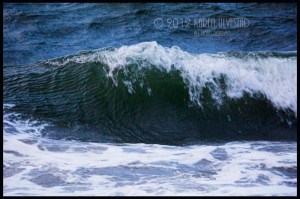
copyright Karen UlvestadThe beach is a wonderful location during high winds or stormy weather. In this photograph, the wave is coming into shore, and is about 4-6 feet tall. It wasn’t raining, but the winds were very strong. It is good to watch the surf, before going onto the beach, to see where the high-water mark is at. Even with this information, the wind can send waves higher on the beach. On the ocean, these are called sneaker-waves. They can pull people into the water, and can be deadly. It is important to be prepared for the environment and weather.

copyright Karen UlvestadIt is important to wear the appropriate clothing for adventures during the winter. Hypothermia can affect those who are not prepared for rain, wind, snow and colder temperatures. It is good to dress in layers, with a good water-repellent shell over the top. The wind will drop the temperature (wind-chill factor), and the cold can hurt exposed areas of skin (hands, fingers and faces). It is important to wear footwear that will keep feet warm and dry. This type of equipment can be found at outdoors stores, such as ski shops or REI.

Camera batteries will lose their charge faster in the colder weather. It is good to bring an extra battery, and keep it in a warm place (pocket near body heat). Most camera equipment is water-resistant, but it depends on the manufacturer and model of the equipment. It is good to keep the gear dry with a good camera bag (water-proof), covering for the camera/lenses and a quick-dry cloth to dry any water that does get onto the equipment.

The photograph below illustrates being prepared for the weather. More later. . .

copyright Karen UlvestadHappy Shooting. . .Karen

Sitka Center Rocks!

Just taught at the Sitka Center for Arts and Ecology last weekend.  Absolutely incredible venue to teach through.  My “Of the Land, Sea & Air – A Coastal Photographic Adventure” filled months ago, and had a waiting list.  The students were great, and the wildlife made its appearance.  The coastal weather was misty one day, and simply overcast the second day.  Overall, a great experience to teach in, and a wonderful school to work with.

The students photographed the Common Murre colony, fledgling Peregrine Falcons, Great Blue Herons, Black Oyster Catchers, Pigeon Guillemot, Black Guillemot and more.  One student watched and photographed a Humpback Whale that was breaching.

The following photographs are from the workshop. . .

copyright Karen Ulvestad
This Great Blue Heron was hunting on the in-coming tide. The mono-chromatic scene in off-set with the orange Starfish, green water and kelp.


copyright Karen Ulvestad
This is one of the fledgling Peregrine Falcons. His coloring allows him to blend in with the rocks of the cliff-side.


copyright Karen Ulvestad
The day was over-cast, and can be seen in the white reflected off the top of the water. The Harbor Seal was swimming in the kelp beds (red), and the green ocean water.  The kelp, water and cloud reflections make an abstract around the seal.


More Later, and Happy Shooting. . .Karen

Rainy Day Photography

copyright Karen UlvestadWith outdoor photography, it is inevitable that we get caught in the rain.  I always enjoy those moments, because it adds a different “feeling” to my photographs.

The weather greatly influences the final photograph.  This one of the Great Blue Heron rookery was taken in March, during a rain shower.  The sun behind me created the rainbow behind the rookery.  Without the rain or the sun, this would have been a very different image.  It would have had a flat sky, with little color.

Rain can be damaging to camera equipment.  It is good to shelter the camera from the rain, though remember that most cameras are water-resistant.  All equipment should be dried off, if it gets rained on.  A chamois cloth works well, dries quickly and fits into a camera bag pocket.  Drying of the camera and lens keeps the it working well.

Also, it’s important to protect the camera and lens being used in the inclement weather.  There are several ways to do this.  If the camera is mounted on a tripod, an umbrella can be held over the equipment to protect it from the rain.  When carrying the camera, a shower cap can work as protection.  Currently, a clear plastic sleeve can be purchased at a camera store.  It fits over the camera and lens, and allows the photographer to slid their hands in the sides to operate the camera.

One of the most important pieces of equipment, in wet weather, is the camera bag.  It is important to have a bag that is water proof, or at least water-resistant.  Many bags, such as backpacks by Tamerc, have waterproof zippers, and fabric that covers the them.  They are built to be in wet weather, without compromising the camera equipment inside.  Also, these bags are well padded to protect equipment from damage.  Many other manufacture’s have good, protective camera bags too.

Happy shooting until next time. . .Karen