Port Susan Snow Goose Festival

Just a quick note. . .

The Port Susan Snow Goose Festival has been canceled for this year. My workshop is also canceled. If you are interested in an in-the-field workshop on that weekend, please leave a comment. I am putting together a small workshop on that weekend, if there is interest.

Thank you & happy shooting. . .Karen

Architecture & Gardens. . .

copyright Karen Ulvestad

Architecture lends itself to both color and black & white photographic images. Often times, it becomes a composition of lines, shapes, and color / tone. The photograph above shows a modern building with the reflection of historic architecture. The old and the new sit across the street from each other.

This is the story of downtown Oakland. It is a city rich in contrasts and opposites.

copyright Karen Ulvestad

The historic Tribune building rises above other period buildings. In this incident, it is framed by a modern sculpture. The primary colors of red, yellow, and blue work together to make the brown & cream colored building stand out in the image.

copyright Karen Ulvestad

Another way to frame a building or architectural element is with living elements. In the photo above, I used blooming cherry trees to frame the Gothic architecture of the University of Washington. In this case, the cloudless blue sky is the perfect background for the pink flowers and brick buildings.

It is great to contrast man-made structures against or with nature.

Happy Shooting. . .Karen

“Architecture & Gardens Through the Viewfinder” ULearn (Edmonds CC), Apr 27 – May 18, 2017 (Thursday nights)

Story Telling in Black & White

051410-klu-2780e

The photo above is one of my favorite story-telling black & white images. This was taken at the zoo, and I loved the wise look on the gorilla. The bonus was the child looking through the glass.

A successful story-telling image gives the viewer an engaging subject with just enough details. Black & white photography cuts out the color, and brings the image to a basic tonal quality. Without the color, the photo relies on the relationship between the elements of the image.

040315-klu-u8a0634bwe

Architecture lends itself to black & white well. In the photo above, the lines, texture, and contrast create a timeless image of a historic house along the Oregon coast. The cloudy sky contributes to the image by fading into the background. The details of the house bring the viewer’s attention to the building.

The linear aspects of architecture, whether historic homes or sky-scrapers, becomes the driving force in the composition. It is more delineated in black & white.

So, what is the story to tell, and should it be color or black & white? Photographer’s choice. . .

Happy Shooting. . .Karen

“Not Your Grandma’s Black & White” ULearn (Edmonds CC), Feb 9 – Mar 2, 2017 (Thursday nights)

Black & White

040814-klu-1967e

Black and white photography uses tonality, contrast, and composition to engage the viewer. It is the origins of photography, and the favorite of famous photographers such as Ansel Adams.

This type of photography takes a different “eye” than its color counter part. The tonality of black and white succumbs to the vibrance of color in color photography. Often, a photographer is good at one or the other, but not both. It requires 2 different ways of “seeing” the shot.

040814-klu-1861e

The mood of the black and white image is more than its tones. The clarity of the image or softness add to the composition. The top photograph evokes a feeling of a storm, while the second is crisp and shows clarity. Each stands on its own composition, telling 2 different stories of the Oregon coast.

I’ll leave with 1 more image. . .

1995-mule-deer-portrait-bwee

Happy Shooting. . .

“The Oregon Coast in Black & White” July 1-2, 2017 at Sitka Center for Arts & Ecology

Spirit of Place

copyright Karen Ulvestad

I cannot teach this workshop often enough! This is the core of a successful photography. The idea is to “capture” the subject’s essence in the 2 dimensional image of a photograph. . .to “tell” a story about the subject.

With people, it is often a smile, tears, or other emotion / action within the photograph. This ideal can be brought to a landscape, wildlife image, or macro subject. Each photographer has their own unique view of the world, and the objective is to share this with the viewer.

Accomplishing this vision includes camera knowledge, composition, “seeing”, and weaving all this into the photographic image.

I love this workshop the most, because we explore all these aspects of photography in the classroom, and strive to combine them in the field. The focus is on techniques, vision, and composition.

I look forward to meeting all the individuals that join this journey to photographic perfection.

Happy Shooting. . .Karen

Photo Walks Are A Hands-on Way To Learn Photography

copyright Karen Ulvestad

Sunsets and Photo Walks seem to go together. It is a great way to learn exposure, while photographing a sunset. Exposure affects the colors in the sunset, whether or not a foreground object becomes a silhouette, or simply how to prevent the flash from going off. It’s helpful to have a knowledgeable photography instructor to help hone these skills.copyright Karen Ulvestad


The Edmonds waterfront is a great place to see the sunset, and experience a photo walk. There is a great abundance of subjects to photograph, including the ferry boats, sail boats, gulls, bald eagles, harbor seals, and more.

I would love to see you at my next photo walk on August 25th, 2016. Sign up is through the City of Edmonds at http://www.reczone.org.

Life is Good!

Karen

Painting With Light on the Oregon Coast

Thought I would share my latest venture. June is the time to teach on the Oregon coast at the Sitka Center for Arts & Ecology. Hope you enjoy & please share. . .Life is Good!

Happy shooting. . .Karen

The Spirit Of Place

The Spirit of Place is one of my ideas or personal concepts about photography. At its core is the idea that photographs are created by the photographer through use of light, exposure, and composition. It is our personal view-point or way we translate the scene in a visual way.

copyright Karen UlvestadThis photo uses shadow and light, lines, and people to create the composition of the place. In this image, the viewer sees the blowing sand (top of dune), the rocky wall in the foreground, and the people making their way up the sand dune. It speaks of man and nature co-existing in the late afternoon light.

Nature is one constant in our lives that is ever-changing, yet remains the same. The challenge for the photographer is to take existing elements, and create a pleasing photographic image. Photography is a tool to document the world around us, yet our personal view-point is always present in our images.

copyright Karen UlvestadThe blowing sand in this photograph creates designs on the sand that mimic the wet sand reflecting the blue sky and the ocean waves. In this image, one could see the hillsides in the background as repeating the wavy shape created by the sand and ocean. The scene is completed by all the people enjoying the beach, whether walking along the water or sitting in the sand. By including people, I have given a reference to the size of the landscape.
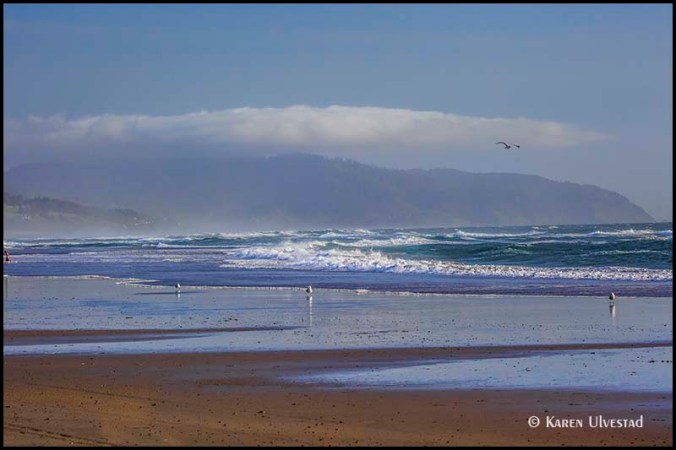
copyright Karen Ulvestad

Another way to look at this scene is to eliminate or hide the man-made or man’s influence upon the scene. By moving the point-of-view, this image the viewer sees the ocean waves and four gulls. Yes, there is some indications of civilization, but they are not the main components of the composition.

copyright Karen Ulvestad

Now to end this entry, I’ve added a little different concept. This image is titled Windy. It leaves the question, how do we as photographers show wind or other elements in our images? What is that special ingredient that we have included to make our photograph stand-out from the millions of images on the internet?

Stay tuned for more. . .or simply join me for my Spirit of Place workshop on the Oregon coast in June.

Happy shooting. . .Karen

Sitka Workshop Went Great

“Excellent instructor – willing to help and make accommodations for all. . .” Student comment. . .

The Spirit of Place workshop I taught at the Sitka Center for Arts & Ecology went great! The students were a fantastic group of diverse individuals with a desire to learn more about photography. We ventured out on our second day to Cape Kawanda (Pacific City), and Neskowin. We practiced the workshop skills photographing the expansive landscape, dories, tide pools, gray whales, and birds. Below is an image of one of the students photographing the dories, as they came into the beach.

copyright Karen Ulvestad

Below is one of my photographs taken of the dories from the beach. The tide was out, and we were able to walk through the tide pool area near the cape. The dories require a fast shutter speed to capture the action with clarity. My students had the opportunity to shoot these experiences, while learning the finer points of exposure and composition. My workshops are balanced between learning in the classroom, practicing in the field, and exploring the possibilities of the photographic medium.

copyright Karen Ulvestad

While exploring the area after teaching the workshop all day, I came across this mule deer buck and a doe. The light was waning since it was later in the evening. The morning had started out with a bald eagle flying by, and the day ended with deer. Sitka is a fantastic place to take workshops with top-notch instructors, and they offer a variety of art classes through-out the summer months. I’ve been blessed to have been teaching workshops through this school for 3 years.

copyright Karen Ulvestad

Happy Shooting. . .Karen

copyright Karen Ulvestad

Sharing a Story in a Photographic Image

Photographs come in many different styles, such as landscape, wildlife, people, and commercial. There are many more that are not listed here. What separates a photograph from others is the clarity of the story it tells. What does the photographer share with the audience that isn’t shared in other images.

The photograph below is a shot of Proposal Rock on the Oregon coast. This area is photographed often by locals and visitors. So the challenge becomes, how does a photographer make his/her photograph different from every other photograph of this beach and rock? In this case, the difference is a pair of shoes with bright colored laces.

copyright Karen Ulvestad

This second photograph utilizes people in a landscape photograph. The viewer first sees the child holding the lens, the railing behind the child, and finally the landscape in the background. This shot is from Waimea Canyon on the island of Kauaii (Hawaiian Islands). The depth of field in this shot give value to its elements. . .the child, the railing, and the canyon. The clouds in the sky add further texture to the image.

copyright Karen Ulvestad

It seems fitting to end with this photograph of a Bald Eagle at sunset. The sunset becomes the sun, color of the sky, and the silhouetted eagle. This is a single shot in the camera, which means it was thought through before the photograph was taken. Planning can help create a one-of-a-kind photographic image.

copyright Karen Ulvestad


This is an excerpt from my upcoming workshop The Spirit of Place at the Sitka Center for Arts and Ecology in June.

More next time. . .Happy Shooting. . .Karen